Marco Paolucci, owner of the JPK 1180 Libertine, once again gives us the pleasure of sharing his race report this year, with a bonus film made by Deea Buzdugan. It’s a gripping account that we invite you to read below! The video is at the bottom of the page.
Congratulations to Marco on his superb 3rd place in IRC Double-Handed and in IRC 5, as well as on all his results from the 2026 season!
Here I am again, during the delivery trip back to Fiumicino, telling the story of how the race went. It has become something of a ritual for enthusiasts, since many people ask me for it and I enjoy doing it: writing is a bit like reliving.
Prelude
My friend Franco and I had brought the boat to Malta from Athens after the Aegean 600 in July. We hauled her out at the MMH yard in Marsa, at the very end of the Grand Harbour creek, a huge place where they maintain ships. It is inconvenient for us, with a terrible smell problem: an animal carcass incinerator is close by, and the smell of death surrounds you. In this atmosphere I laid the boat up in July under a scorching sun, and recommissioned her at the start of October, with more bearable temperatures but still summery. I sanded the whole hull by hand, alone, on 6 October. My son Daniele then came to give me a hand with the rest, and without him it would have been impossible. On launch day I rented a cherry picker and went up the mast to install the wind sensors, the windex and the Locks. In short, before the race had even begun, I was already tired.
As usual, I arrived at Valletta Marina very early. On 9 October, after the masthead session, we reached the dock in the afternoon. They put us in a very large berth at the end of Charlie pontoon, with just us and the Neo 350 Ava there, the others still to arrive.
The plan was to prepare the boat to take part in the Coastal Race, which I have never sailed in 15 years. With Daniele we got everything in order by Monday 12th and the boat was ready. Paolo from One Sails brought us the sails that same Monday, and Niccolò arrived in the evening. We were finally ready for the first training session on Tuesday 13th. We went out with Paolo to check the new jib and the new Code. Deea Buzdugan also came aboard: she is a remarkable photographer, whom I commissioned this year for a dedicated photo and video report.
We decided not to take part in the Coastal Race: too much wind forecast, and breaking something would mean compromising the Middle. On Thursday and Friday, final tests, and we were ready.
The start
The start, as usual split by class, put us second in the order, with the orange flag of the IRC 5 group, at 11:10 on Saturday 17 October. We started well, on the right side of the line, and after a beat in light wind we exited Grand Harbour in the small leading group. We had to set the new Code straight away: heading for Mark 2, with 100° TWA and 12 knots TWS.
We rounded Mark 2 in the middle of heavy boat traffic. We had to change sails for the close reach toward Sicily. The Code furled badly and forced us to bear away to drop it half open. We lost a few places, but it was better than Colombre, who broke theirs. First lesson of the Middle: never bring new sails that you haven’t tested in at least two or three training sessions…
Those Frenchies
A few miles later, the wind freed and the Code came back into play. We hoisted it after unfurling it and stopping it with the miraculous wool (which I always keep on board). We kept it up to Capo Passero, where we swapped it for the A2, which we kept until Ustica. Solenn*, with a Flying Jib set, overtook us. We thought it wasn’t legal, and I ended up lodging a protest which I then withdrew. There is always something to learn from the French: in IRC, jibs can be tacked ahead of the forestay, an interesting thing that opens up unexplored horizons. Be that as it may, the JPK 10.50 is faster at these angles with that sail.
Calm north of Sicily
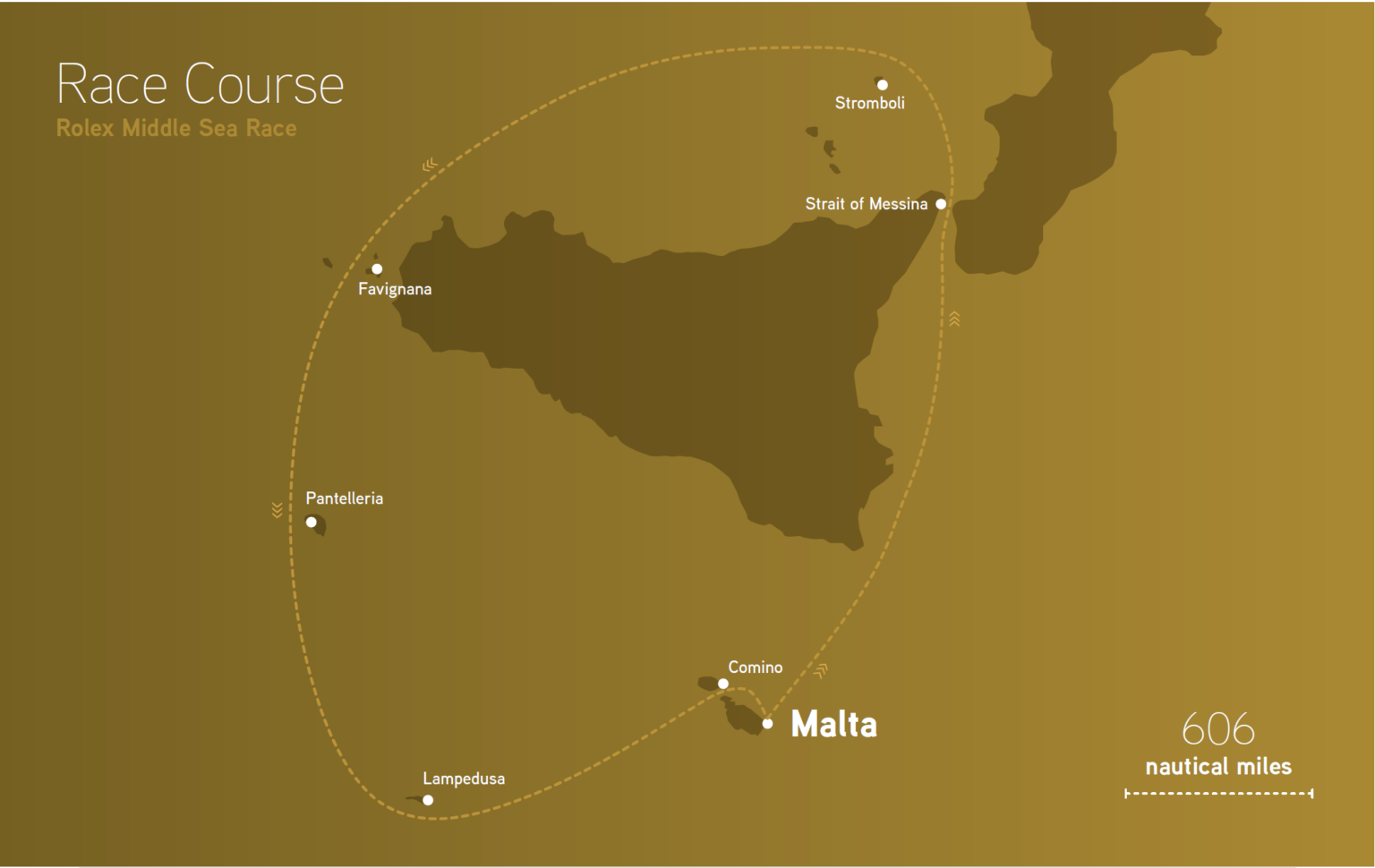
Off Catania, the cards were reshuffled: the forecast front arrived and we got well soaked. These were clouds without wind, and at one point everyone was pointing in different directions, the tracks on the tracker drawing circles. We came out of it leading the DH group. The French lost ground in the little calms, but not Colombre: in the Adriatic, they are good in light air. They were behind, but not far. This time we approached the strait with the current in our favour. We exited on the Sicilian side, close to the Pilone, in a boiling sea that always deceives, and headed for Stromboli, still under the A2. The wind, as we know, does what it wants: we had to go north and gybe 4 times to reach Vulcano, while those behind would go straight with more wind and gain miles on us.
We passed Strombolicchio in the afternoon. The route the weather called for toward Ustica went even further north, with almost the whole fleet busy avoiding the dreaded wind hole of the Aeolians and the coast. Some boats behind tried the madman’s gybe and stayed stuck for hours. We sailed north of Ustica, and three gybes during the night put us on course for the island, which we passed around midday. The wind had tightened and strengthened, to around 10 knots. We changed sails: first the Code, then the A1. Heading for San Vito, we arrived at sunset, and as always in the light transitions, the wind dropped. Colombre was close, too close, and we hadn’t managed to shake them off. In a moment of flat calm we even managed to set the windseeker, which on these boats isn’t as efficient as I thought: better to keep fighting with the A1 as long as it holds.
The Sirocco comes in
We took care not to end up in the wind shadow of Erice by gybing 3 times. Just after passing Erice, the sirocco arrived, which had been blowing for days in the Sicily Channel, raising its famous sea.
We sped along on a close reach, at 55/60° TWA, toward the Egadi Islands. We passed Favignana around midnight, its lighthouse at night is always striking. The wind rose to 27 knots, the sea was rough. The night toward Pantelleria is one of those you don’t easily forget, above all because of the confused sea and the cross waves that form in the Sicily Channel. We sailed with one reef in the mainsail and the J3. The jib vibrated a lot, and with every wave it felt as if the boat was going to disintegrate. I tried to sleep outside, as I have done so many times with the Comet in these situations, but the JPK is uncomfortable: she isn’t made for sleeping, she is made for pushing. The boat asks to be heeled to go fast, she attacks the waves with fury, and you have to put her in a position to do so. The autopilot steered well, even in these conditions, a sign that the work done is bearing fruit. Everyone was pushing, some more, some less. We were faster than Colombre and we shook them off a little, but in the end it would not be enough.
After Pantelleria, the sea calmed a little and the wind eased, still around 20 knots, with a tighter angle, around 36° TWA. We took advantage of the forecast shifts by tacking on the headers and gaining a bit more.
All the way
We reached Lampedusa around 21:00 on 20 October, the wind still around 20 knots. Once past the island, the angle opened up gradually. I started by shaking out the reef, mistaking the halyard in the night: it looks too much like the J3 tack line, blue/black. The tack line’s colour needs to change, to a light one. Then we swapped the J3 for the J2. The angle might have suited an A0, but we didn’t have enough confidence to take the risk on the fourth night, after the previous one spent sleepless, or nearly so. Especially as the boat was going well, still above 9 knots. Solenn*, on the other hand, came back strongly: they held steady above 10 knots, and they later told us they had used the Flying Jib all night.
We arrived at Comino in the morning around 08:00. The channel crossing was in 9/10 knots of wind on a direct course, then on the east side of Malta it rose gradually to 18 knots, with an angle of about 50° TWA. Very gusty, we hand-steered. A single tack and we reached the Fairway Buoy, to be left to starboard, then another upwind leg toward the finish, which we crossed at 10:11:43 UTC on 21 October 2026, skimming the rocks below Tigné Point, while Deea photographed us without our knowing.
Finish
The results are a success for the yard: 3 JPKs on the DH IRC podium, 2 on the IRC 5 podium, a win in IRC 6 as well as in ORC 5 and ORC 6. These are fast boats that have everything needed to win, and Jean-Pierre can be pleased.
Libertine has shown once again that she is a competitive boat. She can still improve, but she must be driven flat out at every moment, pushing performance with no downtime due to fatigue or lack of confidence, otherwise whoever does will overtake you. At this level, everyone is strong: if you push, you win. The understanding with Niccolò has strengthened further, and I am very happy about that, it is a solid base for the future.
Conclusion
My assessment of the 2026 season, now over, is positive: three superb races, finished with two podiums, third place at the Aegean and at the Middle, both DH and class IRC, and a first place on elapsed time at the Paprec (unfortunately without a prize).
It isn’t enough, and next year I will have to change things to reach the top step of the podium. The work on the polars keeps getting more refined, we got the new sails right, but something extra is needed that I haven’t managed to bring out, and I will have to work on it.
The winter will be used to make the right choices for next season, which will have to be different from this one, if only to change the far too long time spent away from home: each race amounts to almost a month, with the round-trip deliveries to and from the Aegean and the preparation of the Middle on top.
The boat now goes to rest on her cradles in Fiumicino, awaiting the next season, which will be, I hope, as exciting as this one, but with better results.
Hugs to you all,
— Marco
*Ludovic Gérard, aboard the JPK 1050 Solenn, has also sent us his race report, which you can find here.