Jacques Valer, the main architect of this victory!
As always, a race is won well before the starting gun is fired: for us, with Alexis, the race began at Spi Ouest France, where we discovered our new toy... and realised we had a fighter jet on our hands! With three out of four races won in all conditions, we promptly realised that we had the perfect machine for the Fastnet.
All of this was preceded by months of work at the drawing board for Jacques and JB, who models and designs, and then by the teams at the shipyard to model the preforms, manufacture the moulds and launch the first boat into production. Everyone gave their best throughout the chain, and a large part of the work was already done thanks to this collective effort.
Arriving in Cowes, our friend James Hynes — who races on Adam Gosling's famous Yes — does his utmost to help us: a place at the Squadron marina, the keys to Adam's villa on Cowes harbour, technical support whenever we have the slightest problem... While I fine-tune the boat's preparation, Alexis checks the weather with Mino (Dominique Vittet) and starts refining the routings until the morning of departure. The wind will be blowing upwind until Fastnet, with very few opportunities to ease the sheets. On the other hand, the return leg looks favourable with downwind conditions of around 18-20 knots to Cherbourg, even if theangles will be well deep downwind.
We're off!
Saturday, 12:40 p.m. The race is on! We secure a good position but without taking any risks, as the penalty for an early start is two hours. The wind is blowing between 10 and 18 knots with lots of shifts. The first crossings are average, but weare back on track before exiting the Solent. The favourites are all there at the front: Lann Ael 3, Solenn, Pilou and Laudato, but also the Pogo RC Aruba and the Danish X41.
At the exit of the Solent, the current pushes hard against the wind and creates short waves, especially as the wind picks up to over 20 knots. With 30 tackmanoeuvres already done, I am getting quite warm despite the English drizzle, and we don't have much time to contemplate the fabulous spectacle of hundreds of boats crossing in all directions.
We set off slightly north of most of our competitors and take advantage of a better angle with the gusts passing over us. That's it, we're in the lead in our class with Aruba slightly behind us. Here we go for two and a half days of close racing! Under high mainsail and J2, the boat is well balanced and we outpace the Pogo RC, keeping our other competitors downwind — and ‘well behind’ us.
The English Channel and the Celtic Sea upwind
The hours tick by, and the next passage to negotiate is Portland Bill, which we must reach as quickly as possible to avoid too much current. The timing is tight but good for us and for the leading group. We can get close to shore with Lann Ael and Pilou, Hervé Châtaigner's JPK 1050 skippered by the famous Gildas Morvan. Things are going well for us on a final tack ashore, we are pulling away from Pilou a little and only Lann Ael remains, close behind us on our leeward side. We don't know it yet, but this head-to-head battle will last 500 miles! For the record, Didier Gaudoux's Lann Ael 3 — skippered by Erwan Tabarly — is the pioneer of this type of scow-shaped, lightweight, planing boat. Didier had the audacity to have this magnificent prototype built to a Manuard/Nivelt design two years earlier, paving the way for others to follow.
The miles are flying by, and for the moment the strategy is perfect, we're opening up quite a gap on the fleet... the race by elimination has got off to a good start! Night, day: the intensity is still the same, especially with a Figaro racer like Alex on board! In the morning, we're approaching Starpoint, another point to negotiate as best we can with the current. Pilou and Lann Ael tacked a little early to head for land, while we adjusted our trajectory a little later so as to arrive at the right time at the point where the onshore current will be the strongest for this point passage. It's great when everything goes according to plan!
The following night, Lann Ael is once again very close downwind — the wind is shifting slightly, speeds are equal, while they owe us 17 thousandths (20 minutes per 24 hours). At the helm, I notice that things are getting busy on their deck: they are hoisting the jib top. At 65° to the wind, I am perplexed, but they are gaining a slight lead. To improve our rating, we had taken down this sail, so we compensate by hoisting our storm jib as a staysail, in addition to the J2. It helps a little, and we hold Lann Ael before overtaking him again at the end of the night.
The Scilly Islands are finally approaching: we're positioning ourselves ahead of them and ahead of Pilou. Pilou is going to take a fatal option at this precise moment, deciding to pass under the DST to anticipate a future wind shift to the left. Behind this trio, Solenn, another JPK 1050 led by Ludo Gérard and the very young and gifted Eliott Coville comes back into the match with super speed. It's at this point that the strategy is fine-tuned, because for the moment the wind is still very much to the right, but with some left-handers to be exploited to get away from Scilly, where the wind is often a little lighter due to the cooler water temperature - I'm joking, because that's our holiday destination in a fortnight's time on the JPK 45 FC Ella!
In short, it's not easy to know when to decide on the definitive left-course tack. As we're both looking at the chart inside, we hear voices. Alex jumps into the cockpit: a Pogo 12.50 - which left Cowes 40 minutes before us - has just tacked to avoid a collision! Phew, we've come to our senses and we won't be caught out again!
We then attack the north face of the course with cross seas and 20-22 knots of average wind. With J2 at the top of the sailing range, the boat is not the easiest to handle, even if the speed remains good compared to the competitors. The miles fly by, with some fine sequences of trimming at each change of tack. We finally approach the Fastnet at dusk, with Lann Ael 3 two miles ahead and Solenn 0.5 miles behind. Aruba, the Pogo RC, is 10 miles behind, as is Régis Vian's Laudato, who is sailing with Clémence, his daughter, on the 4th JPK 1050.
Passing the Fastnet and a long glide in the Celtic Sea
A beautiful run along the coastline, almost touching the tip of Ireland... then passing close to the lighthouse in the twilight and fog... Alex, at the navigation station, gives me the heading and I see the rock appear, topped by the halo of the lighthouse lens. It's very impressive and beautiful at the same time, but we're already looking ahead to the next leg, which looks great for our boat! In the rankings, we're first in the double IRC and 16th overall, which is already great for the first part of the race, which has been 100% upwind.
As soon as we pass the lighthouse, we ease off the J2 sheets. With the DST corner at 110° to the wind and only 2.5 miles away, we decide to play it safe and not hoist the Code 0, because if we run into trouble, we won't have any margin to bear away and manage the situation. Solenn learns this the hard way with an error of judgement: spinnaker hoisted too early... it cuts the DST! It will cost him dearly, second place in IRC double and IRC overall... so frustrating!
Under genoa and at 11-12 knots, the boat is already dropping. We promptly reach the DST corner to hoist the A2. With 20-23 knots, it's the ‘big spinnaker’! We get a serious boost, and off we go for a run in the dark night on a choppy sea. I'm going to stow everything I can in the transom while Alex takes the helm, then I'll keep an eye on the AIS targets ahead of us. The speed differences are pretty crazy: often 2, 3 or even 4 knots difference with all the boats ahead, mostly large IRC 2s that had overtaken us on the upwind leg. We catch up with them in just 1 hour and 10 minutes. Honestly, we're thrilled on board!
Occasionally, the wind picks up to 26-28 knots, which is quite impressive when racing through this minefield. The boat remains stable despite everything, so we decide to simply take in the reef in the mainsail to relieve the bow. We take turns at the helm, with targets appearing in front of us and then disappearing behind us. It's exhilarating!
The day dawns timidly, but with better visibility, it's easier to ride the waves. What a joy it is to glide like this, especially since we've caught up with Lann Ael, who is the only one keeping pace. Three jibes later, we are heading for the Scilly Isles side by side with them, sailing at 15-18 knots. It's great. The IRC 1 group finally appears on the AIS, and once again, the gaps are at least 2 or 3 knots with the leaders in this class, because on Léon we are planing non-stop even though the wind is starting to drop a little. Fast Wave, l'Ange de Millon, Patanegra... the top boats in IRC 1 are swallowed up one by one, even though they started 40 minutes before us!
Last challenge: the Raz Blanchard
We aim for the lower middle of the Scilly DSTs and head for the tip of Cornwall in a dying wind. 16... 12... 10 knots... the planning is over. At least this helps us to distance ourselves from Lann Ael, who are a little less comfortable than us in this gradually weakening VMG. Alex is very attentive to the wind shadows off the English coast, as recommended by Mino: never closer than 40 nautical miles. As soon as the wind shifts, we gybe towards the French coast to regain pressure.
We are entering our last night at sea, enjoying easy conditions as the wind picks up again with well-ordered waves, allowing the boat to plane effortlessly. We are going flat out: we know that we are playing a very strong card in the class, but also in the overall standings. For the past few hours, the routings have been giving us favourable timing to pass the last obstacle of this race, the famous Raz Blanchard. Everything could be lost there, but we have been pushing hard for 36 hours downwind to be in the right phase with the current.
A little ahead of our planned route, we hit the front of the tide change very slightly... but Alexis — who knows the area like the back of his hand — guides us under the road to attack from the south of Alderney at slack tide, and be the first to take advantage of the tide change. We luff 10° under a tight spinnaker with J3 and storm jib, but the apparent wind picks up a little with the current pushing us along. So we replace the spinnaker with the Code 0 to start the Raz, a real "cauldron" even though the real wind is only 8-10 knots!
Once we finally pass Pointe de la Hague, the breeze dies down dramatically! With 6 knots of wind and a 2-knot current—coming straight from astern, to make matters worse—the last leg to Cherbourg can be tricky. We move away from the coast to maintain some pressure, but we must be careful not to go too far in case the wind drops completely: we don't want to miss the finish line by getting caught in the current!
After 5-6 jibes, we finally set our course for the arrival pier at the port of Cherbourg, with quite a few support boats around us, which is always a good sign!
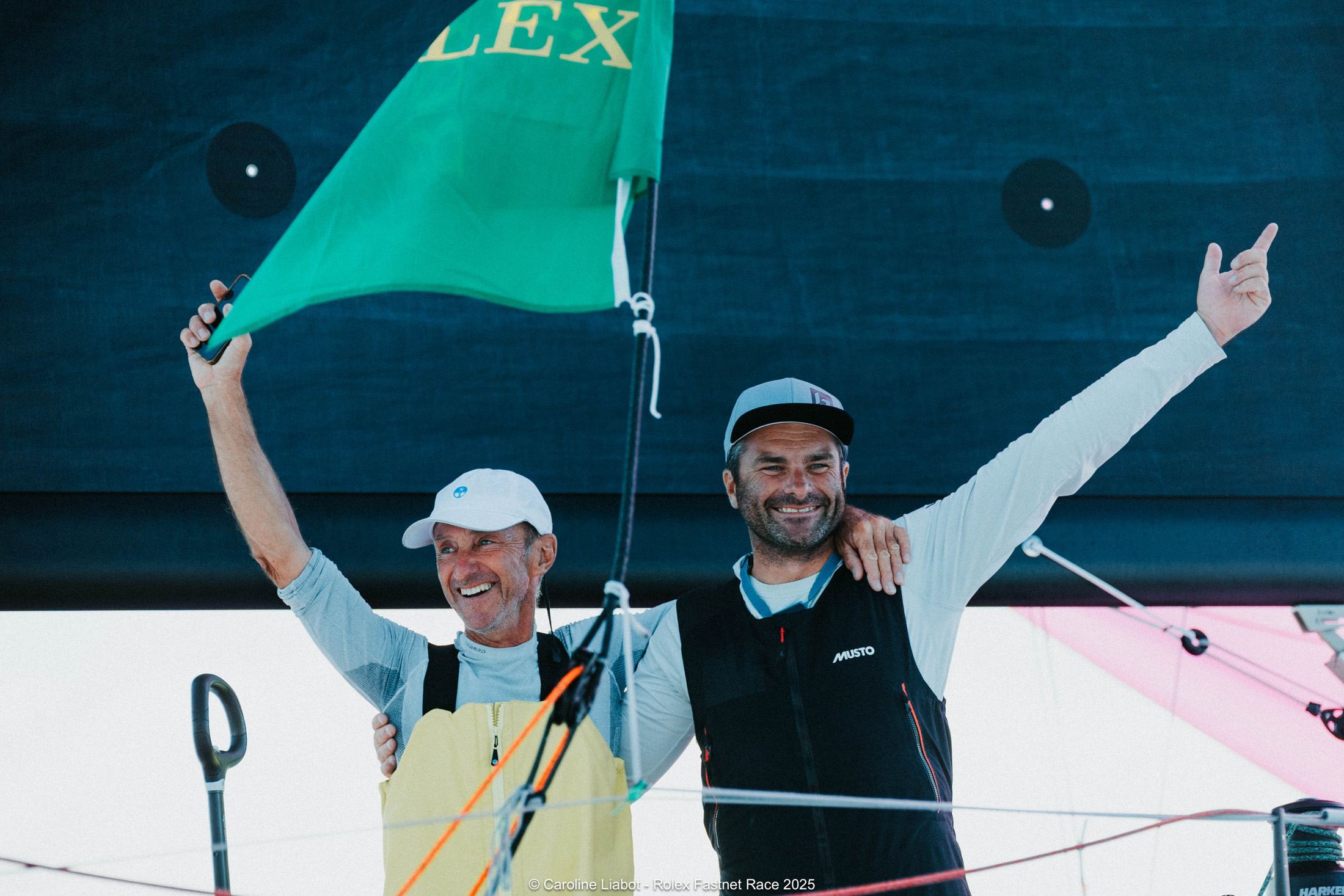
Time's up: we're first in IRC double, IRC2 and, most importantly, first overall, which is just crazy!
For Alex, it's an emotional moment, as he wins the overall doubles title once again – and at home – after an unprecedented victory in 2013 in the doubles with his father Pascal on Night and Day, the JPK 1010. For me too, it's an emotional moment, because I think back to the genesis of the project, the hours of discussion with Jacques and JB about the design, then with Jean-Michel and the whole JPK team to bring out this little gem that's so much fun to sail... Clearly, we had the perfect race with Alexis, who was excellent as always.
Jacques Valer can be proud of himself, because in all the classes his boats have achieved improbable scores: eight boats in the top ten in IRC 4, four boats in the top six in IRC double-handed, and so on.
Even better: almost all the JPK boats designed by Jacques Valer have won the Fastnet! JPK 1010, JPK 1080, JPK 1180, JPK 1030 and now JPK 1050 ...
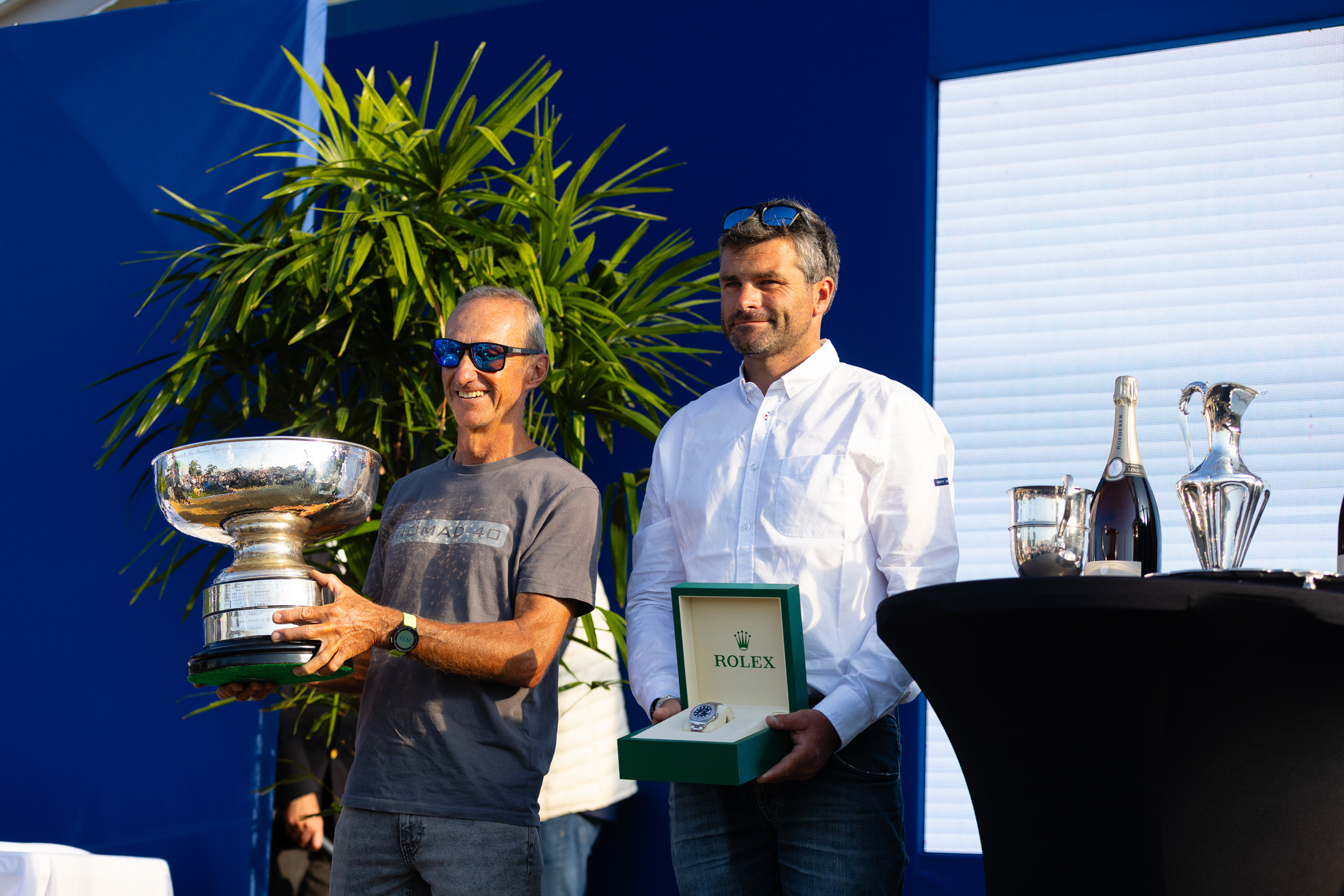
The trophies are now in the yard for two years, and Alex has a beautiful Rolex on his wrist!